
2007/11/29
2007/11/28
Lanvin


The campaign for winter07 will remain in the collective consciousness for years to come. Excellent iconographic
 use of color and shape.
2007/11/27
Al shaarani

 Born on 6th of September 1952.
Student of the great Syrian calligrapher, Badawi Al Dirany.
Graduated in 1977 from the faculty of fine arts, Damascus University.
Worked as a calligrapher since 1967, then as a designer of books and various printed matters as well as a designer of typeface character.
Published booklets for teaching six kinds of Arabic calligraphy (Dar Aleef-Tunis).
Contributed a number of articles as an art critic, and others on Arab Islamic art.


My blueberry nights
STARRING: Norah Jones, Jude Law, Rachel Weisz, Natalie Portman, David Strathairn
DIRECTOR: Kar Wai Wong
DIRECTOR: Kar Wai Wong
2007/11/26
A backstage Flickr collection
 Sometimes models BORE me...sometimes they amaze me. Here you have so you can either be bored or amazed.
2007/11/25
Sexy Oskar


The Sartorialist came across this FANTASTIC individual in the streets of NYC. I have to diseminate the awesomeness that this woman is: A truly sartorial gender rebel!
Hot isn't she?
-From NY Mag.-
Oskar Tarplee, Muse
"I spend a lot of time getting dressed till I find something I love, and then I’ll wear it for days until it’s way too dirty to wear anymore."
By Amy Larocca
You’re really comfortable in front of the camera.
People stare at me wherever I go. I’m not sure if it’s the way I dress, the way I carry myself, or what, but I like to play with it. I see people watching me, taking my picture, and I can create a moment for them.
Is Oskar your real name?
My family disowned me about ten years ago because I’m gay. I’m from Georgia, so they’ve got that whole Bible Belt thing going on. So I came up with my own name, because it’s just like, Who’s Oskar? It’s nobody. I’m not on that whole kick of wanting to be a man. I want to be able to be a sexy woman who has masculine traits. That’s it.
Do lots of people take your picture?
A few years ago, I was homeless. So I was living on the streets, and Elite modeling agency found me in Union Square; some guy came up and asked if I could do a shoot in London the next week and I said yeah, and they sent me to take a shower because I smelled bad.
Do you still model?
They told me if I wanted to make money, I’d have to present myself as more of a feminine personality, and I was like, “Fuck that.”
So what do you do?
I’m a warrior of types, gathering awareness, searching for that, really. I’m basically a muse for people, and they give me information in exchange for hanging out.
So what is a typical day like for you?
I’m really just day by day. Like tonight, I’m performing at the Box. I pretend I’m fucking a corpse.
Do you spend a lot of time on your look?
I spend a lot of time getting dressed till I find something I love, and then I’ll wear it for days until it’s way too dirty to wear anymore. It’s fun getting dressed up.
2007/11/24


2007/11/23
Over shoe shoes

Interesting idea. But not for me. Bigger shoe sfor your shoes...MMM.
I like their website better.
Bela Lugosi's Dead
After concentrating on the sounds and leaving the face features of the lead singer behind you can appreciate the beauty of he most interesting Gothic Flavor: Bauhaus.
I recommend "third uncle" as one of the best songs ever.
2007/11/15
2007/11/13
2007/11/09
Sandwish jump
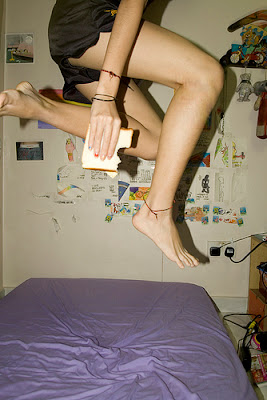
While visiting the blog of Alec Soth -one of my fav. photographers -I came along with a contest he is running:
"Your assignment, if you choose to accept it:
"Your assignment, if you choose to accept it:
1) Photograph a woman* eating a sandwich** while jumping*** onto a bed.
2) Post the picture**** here: http://flickr.com/groups/alecsoth/
3) I will award a prize to my favorite assignment."
Here is my fav. photo from the assigment:
Another day another brand
I got entangled in the whole "negative space" use... All the black surrounding the moving images, the croppings, the editing are more interesting to me than actually the video narrative or the clothes....As a designer this piece works for me in levels different than the clothes. (source)
Taste
I found a video from Sir John Hegarty (Brit. advertisement) talking about taste and marketing. After I watched many things seemed incredibly simplistic...
(source)
I have a background in law. From that educations I learnt that the desire for power (dominance in hierarchic structures) is something people "are born with", supposedly something natural (totally debatable). From this premise we can say that maybe taste -as a permanent struggle of understanding a set of codes that create dominance, granting us some power - is something we are born with. There are MANY different set of codes or taste as there is many elites.
The questions would be then:
-Who really has awareness and ownership on this search for "set of codes" called taste ? and -Who has better taste, the one that appeals to the most economically powerful or the one that appeals to the many
... It is a postmodern world after all.
(source)
I have a background in law. From that educations I learnt that the desire for power (dominance in hierarchic structures) is something people "are born with", supposedly something natural (totally debatable). From this premise we can say that maybe taste -as a permanent struggle of understanding a set of codes that create dominance, granting us some power - is something we are born with. There are MANY different set of codes or taste as there is many elites.
The questions would be then:
-Who really has awareness and ownership on this search for "set of codes" called taste ? and -Who has better taste, the one that appeals to the most economically powerful or the one that appeals to the many
... It is a postmodern world after all.
2007/11/08
HORST OldSchool

 "In the history of twentieth-century fashion and portrait photography, Horst's contribution figures as one of the most artistically significant and long lasting, spanning as it did the sixty years between 1931 and 1991. During this period, his name became legendary as a one-word photographic byline, and his photographs came to be seen as synonymous with the creation of images of elegance, style and rarefied glamour.
Born on 14 August 1906, Horst Paul Albert Bohrmann was the second son of a prosperous middle class Protestant shop owner, Max Bohrmann and his wife, Klara Schoenbrodt.
...
The first pictures that carried a Horst credit line appeared in the December 1931 issue of French Vogue. It was a full-page advertisement showing a model in black velvet holding a Klytia scent bottle in one hand with the other hand raised elegantly above it... Horst's real breakthrough as a published fashion and portrait photographer was in the pages of British Vogue... starting with the 30 March 1932 issue showing three fashion studies and a full-page portrait of the daughter of Sir James Dunn, the art patron and supporter of Surrealism. " SOURCE
2007/11/07
Apache legend film by french
 Gorgeous animation by a group of french students based on an Apache legend.
Click on the image to watch.
Flute by Vincent Molino from Radio Tarifa (one of my fav. musicians)
2007/11/01


2007/10/30
Venezuela Giving Danny Glover $18M to Direct Film on Epic Slave Revolt

by Rory Carroll
CARACAS, Venezuela - Venezuela is to give the American actor Danny Glover almost $18m (£9m) to make a film about a slave uprising in Haiti, with President Hugo Chávez hoping the historical epic will sprinkle Hollywood stardust on his effort to mobilise world public opinion against imperialism and western oppression.
The Venezuelan congress said it would use the proceeds from a recent bond sale with Argentina to finance Glover’s biopic of Toussaint Louverture, an iconic figure in the Caribbean who led an 18th-century revolt in Haiti. 0521 04
It will also give seed money for a film version of The General in His Labyrinth, Gabriel García Márquez’s novel about the last days of Simón Bolívar, who liberated much of South America from Spanish colonialism.
The project could mark a breakthrough for Villa del Cine, a new government-funded studio outside the Venezuelan capital, Caracas, which is part of Mr Chávez’s effort to combat what he sees as American cultural hegemony.
Toussaint Louverture is a towering figure in the region’s history. A freed slave of African descent, he led thousands of slaves in successful campaigns against British, Spanish and French troops before being betrayed, captured and exiled. He died in 1803, just before his followers succeeded in establishing the island’s independence. William Wordsworth wrote a sonnet about him. Glover said he wanted to educate the US about the story. “It’s been essentially wiped out of our historic memory, it’s been wiped clean.”
Venezuela’s congress, which consists entirely of Chávez supporters, also said it would give $1.8m to develop a screen treatment of The General in His Labyrinth, by a Venezuela-born director, Alberto Arvelo. Some rate Gabriel García Márquez’s account of the final days of Bolívar along with the Colombian writer’s better known novels, One Hundred Years of Solitude and Love in the Time of Cholera.
To build consciousness of what Mr Chávez calls “21st-century socialism”, the government has funded nationwide screenings of Charlie Chaplin’s classic film Modern Times, about the exploitation of US factory workers during the depression.
Guardian Unlimited © Guardian News and Media Limited 2007
2007/10/29
Augmented Sculpture
Augmented Sculpture
Pablo Valbuena's project is focused on the temporary quality of space, investigating space-time not only as a three dimensional environment, but as space in transformation.
For this purpose two layers are produced that explore different aspects of the space-time reality.
On the one hand the physical layer, which controls the real space and shapes the volumetric base that serves as support for the next level.
The second level is a virtual projected layer that allows controlling the transformation and sequentiality of space-time.
Monogram in superflat world
While doing some research about monograms for a project I'm working on, I came across this cute video of Takashi Murakami past work for Louis Vuitton. Cute stuff nontheless.
2007/10/28
FRINGERIE


Achiving a good solution that is simple is one of the great challenges of design; the lamp "fringerie" by Dotting design is a good example of this achievement.
I love the textural quality of the lamp...kind of sexy lamp dishabille.
2007/10/26
2007/10/23
Kid's Wear

 A magazine for parents that want to initiate kids into the obscure world of trend setting and its subsequent required consumerism has to have Kate Moss eating some fries with fly kids on the cover, and some poems by Bokowski.
Fresh is the name of the game specially in the perpetual infant world.

fav. euro electro trash band
Love to listen to Vive La Fete while designing and sipping my 3rd spresso. You can actually keep watching more of their videos trough this window thanks to you tube! At end of the video click on any of their other videos, I recomend "Ne touche pas ".
2007/10/22
personal che
Colombo/Brazilian production about the revolutionary ICON. Click here for the official site
The national/ daugters of the soho riots
Came across the music of The National and cinematography work of Vincent Moon something about three years ago after a trip to Paris that left my soul in a continuous disaggregation... Here is one of my favorite songs ever.
2007/10/21
Humanistic


Fashion editorials become just blah when not being able to establish a direct relation between the nature of the clothes and an ideal context in which they would exist, creating a cohesive story for the clothes engaging the audience. I find that the last Teen Vogue manages to present a credible experience for the Fall 07 Balenciaga collection, while generating a high and wide sense of respect for the the clothes identity: a sublime merge of culture and aesthetics. Well done teen vogue.
Stella McCartney HOT Shoes

 Shoe shapes are one of the most capricious and ever evolving trends. Now, when you make a a shape that is different and still holds a strong identity you have a hit.
2007/10/20
Solveiga and Alfredas Krivičiai


 "Ethics and Aesthetics is the same"
L.Wittgenstein
"Ethics is the condition of the world.
Beauty cannot change the world
Life is more important.
Art does not exist.
Creation is an act of ethics.
Art is an interpretation.
One cannot buy art.
(but you can sell it).
Art does not exist.
Jewellery is the process of making adornments
Adornments is not art.
Jewellery is art.
Art does not exist."
"…a lot of people see jewellery making simply as the production ornaments and accessories, the value of which is measured by the kinds of materials and techniques used. In such cases jewelry making is just a craft. It differs from mass-produced goods only in the sense that it is made in smaller quantities….
This does not only apply to jewellery. Paintings which are considered to be fine art are sometimes no more than interior decoration. They are used to “dress up” a room the same way as jewellery is used to dress up a person…
On the other hand if jewellery is art, can it really remain indifferent to the cultural, technological and social changes taking place at the moment in the society?
Should jewellery just concentrate on aesthetic and decorative issues? Or is it supposed to be relevant? If not doesn’t it become no more than the pretty and expensive toy of a cultural elite and jewellery nothing more than appendage to adorn a wealthy person?
Can jewelery react actively to social processes? Can it be socially engaged? Or maybe these days jewellery can, albeit indirectly, express people’s aspiration and phobias, actively and perhaps even dramatically react to the “now”..."
Solveiga Krivičienė
Born 1965 in Rokiškis
1986-1991 studied at Vilnius Academy of Arts
Alfredas Krivičius
Born 1961 in Trakai
1980-1985 studied at Kaunas University of Technology
Both live in Vilnius, Lithuania.
2007/10/17
Guido Mocafico
 Of Italian descent, Guido Mocafico was born in Switzerland in 1962.
A specialist in still life, he works regularly for international magazines such as Numèro, Paris Vogue, Big, The Face, Self-Service, and Wallpaper. He has also undertaken numerous advertising campaigns for Gucci, Yves Saint Laurent, Clinique, Shiseido, and Hermës.
Over the past four years, Mocafico has been at work on a personal project related to architecture, and he continues to explore aesthetic and scientific themes in nature. He lives in Paris.
a fav: 6267 Commercial appeal

 All the trends in one collection! That is how I see the very edited and very wearable 6267 collection. The military that clashes with colonial and oriental motifs keeping all very refined and still edgy . I'd love to wear any of these pieces, they are not so totally dull as many of the full blossom collections I've seen for spring 2008
 "Tommaso Aquilano and Roberto Rimondi have been designing anonymously for a big-name Italian manufacturing house for long enough to know exactly how beautiful clothes are put together. And now, with their label, cryptically called 6267 (it’s Rimondi’s clothing ID number from his childhood summer camp), launched in 2004, they have been able to wed their technical skills with design innovation. With this sophisticated collection, the design duo combined detail from Spanish matador costumes with a sleek, narrow-skirted line that evoked the mid-century couture exaggerations of designers like Jacques Fath and Christian Dior—all executed with a refreshingly twenty-first-century lightness of touch. Some of their silhouettes and deft draperies owe a debt to Roland Mouret. But the meticulous attention to detail couture fabrications, and seductive palette (cocoa, lilac, old rose, copper, ink) set them apart as exemplars of accomplished modern elegance."
2007/10/11
Doris Lessing wins Nobel

Novelist, Story Writer, Autobiographer, Poet, Playwright.
Active 1948- in England, Britain, Europe; Zimbabwe, Southern Rhodesia, Africa
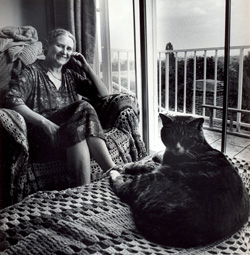 |
Doris Lessing, 1984. © Marianne Majerus |
Doris Lessing is a visionary writer. Now in her eighties, her output is still prolific. Her huge body of published work, for which she is internationally acclaimed, includes novels, stories, non-fiction, poems, plays and opera libretti. She has recently received, among other honours, the David Cohen British Literature Prize, the Companion of Honour from the Royal Society of Literature and the Golden PEN Award for a Lifetime's Distinguished Service to Literature. Her depth and range of vision encompasses concerns about environmental disaster, the threat and consequences of warfare, the collision of race and culture, the collapse of political and social systems and the dynamics of the family. Archetypal narratives of quest and invasion (often in the form of colonisation) recur throughout her writing. The earliest stories were published in Southern Rhodesia (now Zimbabwe) in 1948, while her twenty-fourth novel, The Sweetest Dream, which explores the transience of political ideologies, was published in 2001. A new collection of four novellas, entitled The Grandmothers, was published in 2003. In lighter vein, Lessing has written several books about cats, her favourite animal, and published her most recent poems on playing cards (INPOPA Anthology, 2002). Not only do her books span more than half a century, they also display a great formal variety, including generically hybrid texts, dystopian, fabular, inner space and space fiction, and closely observed social realism.
How does one begin to understand the complexities of Lessing as a writer and the ways in which the experiences of her life have shaped her work? A passage of introspection from the first volume of her autobiography perhaps provides one useful key to understanding Lessing's writing. She describes her own mind-set as “that emotional or psychological double helix coiled at the roots of my nature” (Under My Skin, p.357). A disposition which reserves the inner axis of self while exploring different political or social ideologies has often caused her to change direction rather unaccountably (p.398). Her self-analysis is suggestive of a multi-layered and restless imagination and may explain the ease with which she frequently writes books of different forms and genres simultaneously.
Lessing was born Doris May Tayler on 22nd October 1919 in Persia (now Iran) where she lived until she was five. Her mother, formerly Emily McVeagh, had been a sister at the old Royal Free Hospital in the East End of London, where she had nursed many wounded soldiers from World War One2007/10/10
"Helena Hörstedt is...
 a Swedish design label. It was created after my graduation from Beckmans School of design, Stockholm, 2004. The label provides handmade garments with emphasis on structures and techniques, advanced details and classic tailoring.
I think the genuine work and the handcrafted feeling gives an irreplaceable value to the garment. The trade of handcrafting is always one of the most important sources for both construction of and inspiration for my design. I want my garment to be a fascinating visual experience as much as a usable. I want them to build a desire, continuously expand and to surprise the beholder."
 Dresing up with dramatic clothes, how fun! The same design found by Mr sartorialist in Paris last week.
2007/10/09
2007/10/08
anonymous LV nurse for sale

 Mr. Jacobs is a genius when it comes to being a merchant of the visual... and having so many thousands of complacent individuals as clients I guess this new season's "concept" will be a hit even when it is all reduced to a perceptual color scheme. You can get both fashion and art in one bag!
Richard Prince has an ongoing exhibition at the Guggenheim Museum here in NYC. I would dare to say that -on Prince's work- there are reminiscences of the same treatment of "femininity" that Terry Richardson gives to the subjects of his work: feminine take from a sexual perspective only, I'm afraid. Unidimentional femininity for LV...? Maybe D&G.

 "Richard Prince: Nurse Paintings
FROM www.sadiecoles.com
When asked about these paintings last year, Richard Prince said ‘I’m painting nurses. I like their hats. Their aprons. Their shoes. My mother was a nurse. My sister was a nurse. My grandmother and two cousins were nurses … I like the words nurse, nurses, nursing.’ Painting over large inkjet prints of pulp paperbacks, each featuring a pretty, melancholic-looking nurse, Prince has created a vivid series of canvases that sit somewhere between his appropriated photoworks and joke paintings; the subject matter bringing to mind his Girlfriends series, as well as works such as Untitled (Three women looking in one direction), 1980.
Exaggerating the garish palette of these sixties covers, everything is painted out except for the titles of the books and the nurses themselves, who are washed over in various pastel shades and given white slashes across the face in approximations of surgical masks. The books’ titles – which include the classics Heartbreak Nurse, Dude Ranch Nurse, Aloha Nurse and Danger Nurse at Work – are left as grand captions over each image, with any other characters or text painted out in expressionist gashes of colour (although tantalising fragments of handsome doctors and cheesy bylines such as ‘Could her love thaw his frozen heart?’ are allowed to come through the layers of paint)." sourceFrom nursingadvocacy.org: "The masks in particular point to critical problems today's nurses face, namely their invisibility and difficulty in speaking up for themselves. Nurses are poorly understood--as if hidden behind masks--but many feel they urgently need to shed them, to tell the world what they do and why it matters, to move, in Buresh and Gordon's phrase, "from silence to voice." In some of the paintings, the nurses' eyes burn out over the mask. This suggests real, sentient beings struggling to assert a genuine identity, and to overcome the obstacles placed in their way by the very society they are trying to save. Though it's unlikely Prince intended it, it's possible to see this exhibition as a harsh but constructive critique of nursing's invisibility and a call to action. As one veteran nurse noted in reaction to the paintings: "The masks are killing us.""
if you wanna read more about nurses here
Subscribe to:
Posts (Atom)
Blog

- MARIA H
- Compilation of aesthetic manifestations beyond compliance, bring us emancipation.